Springs · Mount Pleasant
Garage Door Hinge Replacement in Mount Pleasant
Every time the door goes up there is a sharp pop from the same spot, about a metre off the floor, and the whole door gives a little shudder. Come back down and it happens again at exactly the same place.
Garage Door Hinge Replacement
In plain words
Winter puts the lowest hinges through the most. Slush and road salt land on the bottom two joints, and the salt eats into the galvanizing where the leaf meets the pin. A bottom seal frozen to the slab is the other winter classic: the opener pulls on the top panel, the door stays put, and the hinges and top fixtures take a wrench they were never built for. Hinge replacement puts new galvanized steel on the worn joints, straightens or renews anything bent in the tug, and ends with two habits, a clear threshold and a wipe of the low hardware, that keep the new set sound.
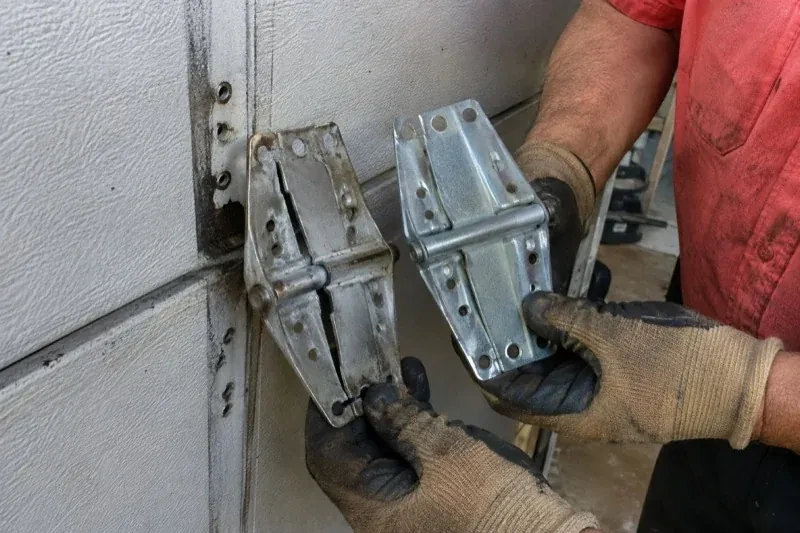
How the visit goesWith the door closed and a flashlight on the inside face, one of the hinges near the edge has a crack running from the screw hole to the knuckle. The steel around it is brown with rust, and the pin looks loose in its barrel.
Mount Pleasant
How the visit goes
Why the hinge gave up
The technician wants the reason as much as the symptom. A door that is out of balance is dragged by the opener, and each hinge takes a share of that force many times a day. A vertical track that has shifted pinches the panels at the curve, and the hinge at that height flexes until it cracks. A bumper touch bends an edge hinge in a way that shows up as rubbing panel edges. Vibration alone works screws loose over the years. You will be asked what the door was doing before the hinge failed, because a stiff, jerky or noisy door before the break points to the cause.
One hinge at a time, door closed
Hinges are changed singly, never a whole joint at once. With the door closed and the opener disconnected, the technician removes one worn hinge, fits its replacement and tightens it before moving to the next, so at every moment the joint is held by its other hinges and the panels stay aligned. Centre hinges go first when several are due, then the edge hinges. Each new hinge is set square to the joint line and snug to both panels before the screws are driven home, and the panels are checked for a flush face afterwards. This steady rhythm is what makes hinge work routine rather than eventful.
Screws you can tighten and hardware you leave alone
Hinge screws loosen with vibration and temperature swings, and snugging them with a socket wrench once a year is a homeowner task; do it with the door closed and the opener disconnected. The hardware to leave alone is the bottom bracket in each lower corner, which anchors the lift cable and is under spring tension whenever the springs are wound; many doors fit tamper-resistant fasteners there for that reason. The springs, cables and their brackets are the technician's job. Knowing which screws are yours and which are not is what makes the annual tighten-up both useful and uneventful.
Garage Door Hinge Replacement
In the van
- Carriage bolts, nuts and washers
- Panel strut
- Hex-head self-drilling screws
- Heavy-gauge hinges for heavy doors
- Flashlight and level
What affects the quote
Same fees day, night or weekend
1Track or balance problems found
If the inspection shows a track out of line or a door out of balance behind the hinge failure, correcting it is explained and priced on its own alongside the hinge work.
2Opener adjustment afterwards
A door that folds freely again sometimes needs the opener's force and travel settings reset and its reversal retested. That adjustment is named when it is needed.
3Supporting the panel while hinges are changed
A heavy insulated panel needs to be braced while its hinges are off, so it does not sag or twist out of place mid-repair. Lighter steel or wood panels usually need no extra support, and the technician decides which applies once the panel is in front of them.
Garage Door Hinge Replacement: questions
Do the rollers get replaced with the hinges?
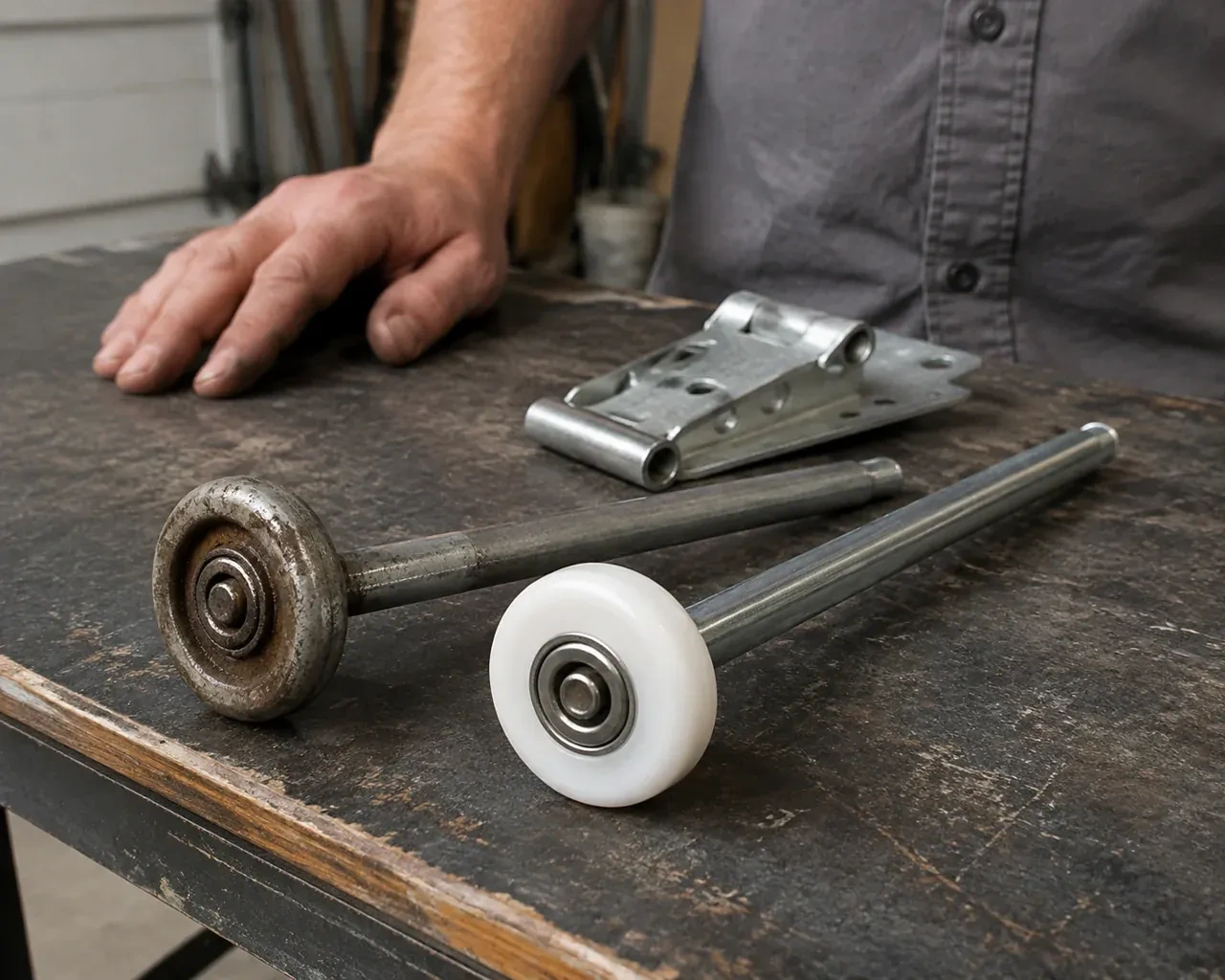
They are checked every time and replaced when they need it. The roller stem sits in a tube on the edge hinge, so when that hinge comes off the roller is already in hand, and fitting a new one adds a minute. A wheel that is cracked, flat-spotted or grinding on its bearing is the sort of thing that strained the hinge, so leaving it would ask the new hinge to carry the same load.
Is the bracket at the bottom corner a hinge too?
No, and it is the one piece of hardware on the door that stays untouched during hinge work. The bottom bracket in each lower corner holds the bottom roller and anchors the lift cable, so it carries spring tension whenever the springs are wound. Many manufacturers fit tamper-resistant fasteners there. Changing a bottom bracket means unloading the springs first, which is a separate job with its own method.
Can I tighten loose hinge screws myself?
Yes, hinge screws are a homeowner task. Disconnect the opener, leave the door closed, and snug each hinge screw with a socket wrench without forcing it, since overtightening strips the hole. Leave the bottom brackets alone; they anchor the cables and are under spring tension. If a screw spins freely or a hinge is cracked, stop there and have it looked at, because a stripped hole needs a fresh anchor rather than more turns.
Springs & Hardware
- Garage Door Track Repair or ReplacementThe door climbs crooked, one side clearly ahead of the other.
- Garage Door Cable ReplacementAfter years of slushy winters the cables look thinner near the bottom brackets, with rust streaks…
- Torsion Spring ReplacementThe door starts to rise, gets about the height of your knee, then shudders and reverses.
Garage Door Hinge Replacement near you
Everything we do for garage doors in Mount Pleasant starts with a proper look at the whole door. From there the service might be a small adjustment, a set of new rollers, a spring replacement, an opener repair or a new door. The pages here explain each option so you can follow the reasoning.